JDKRUEGER&COAcademySign inDE
Module 2 of 5 · eCommerce Fundamentals

The Online Shop Canvas: The Nine Fields

⏱ 25 min · After completing this module, you'll be able to map your business model across the nine fields of the Online Shop Canvas, with the value proposition at the center, and use the Canvas as a management tool by checking every initiative against the field it affects and making sure your offer, customer segments, and channels all fit together consistently.
← eCommerce Fundamentals The Online Shop Canvas: The Nine Fields 1 / 26
continuing in 5
Start

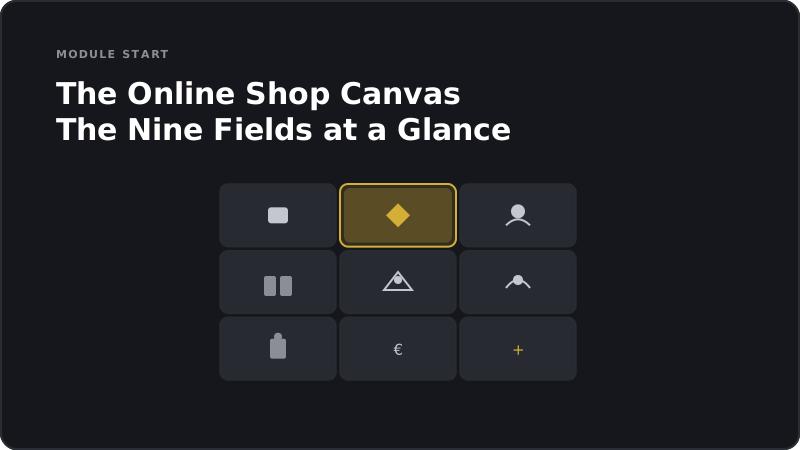
The Online Shop Canvas: The Nine Fields

From the Business Model Canvas to a practical tool for your shop: all the building blocks at a glance.

The Nine Fields as a Management Tool
Transcript of this slide

Welcome to the second module. In the first module, we covered why a Canvas works better today than a rigid document. Now we're looking at the nine fields of the Online Shop Canvas. Once you understand these fields and how they interact, you'll have a tool that lets you run your shop with much more precision.

Learning objective

What You'll Learn in This Module

You'll know the nine fields of the Online Shop Canvas and what each one means.

  • You'll understand why the value proposition sits at the center.
  • You'll be able to use the Canvas as a management tool for scenarios and decisions.
1
Meet the nine fields
2
Understand the center
3
Apply the canvas
Transcript of this slide

After this module, you won't just be able to describe the Online Shop Canvas. You'll actually be able to read it. You'll know what question each field answers, why the center matters so much, and how to use the Canvas to make decisions faster and with more confidence. That's the foundation for everything that follows in the coming modules.

Self-check

Quick Self-Check

Can you map your current business model across nine fields?

  • Do you know what your core value proposition is?
  • Have you ever run through different scenarios with your business model?
Three Questions About Your Current CanvasThree Questions About Your Current…
Three Questions About Your Current Canvas
Transcript of this slide

Before we dive into the nine fields, a quick honesty check. Most shop owners carry their business model in their head, not on paper. That's not a problem in itself, but it's exactly why decisions so often feel difficult. The Canvas is how we change that, systematically.

What this means for you

What Does This Mean for Your Shop?

Without clearly defined fields, your offer, customers, and channels blur into one opaque mass.

  • A Canvas forces you to test every decision against the nine building blocks.
  • That's how you spot early on where your model is solid and where it's starting to crack.
With Canvas: Clarity. Without Canvas: Fog.
Transcript of this slide

The practical value is straightforward. When you use the Canvas, you no longer have to guess whether a marketing initiative fits or whether a new product makes sense. You simply ask: which field does this affect? Does it align with the other fields? That kind of clarity saves time and money.

Concept

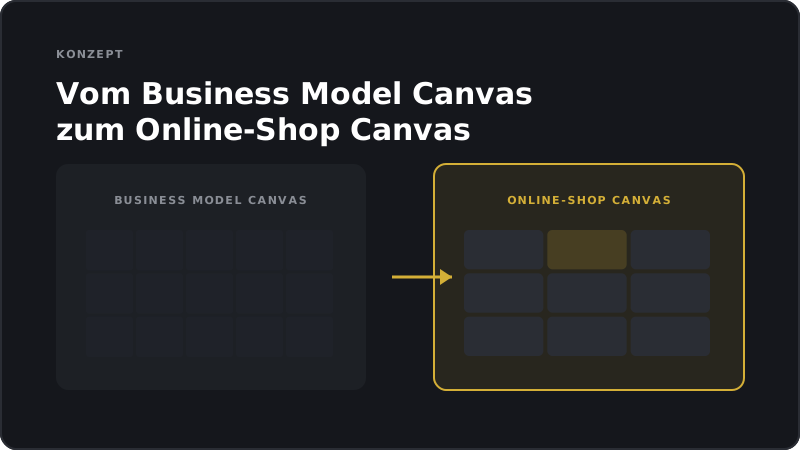
From the Business Model Canvas to the Online Shop Canvas

The Business Model Canvas by Strategyzer and Business Model Foundry is the proven foundation.

  • The Online Shop Canvas translates that logic into e-commerce: products, channels, customer relationships, and scalability.
  • It stays visual, modular, and easy to update with sticky notes.
Proven Foundation, E-Commerce-Specific Adaptation
Transcript of this slide

Most people know the Business Model Canvas. It's an excellent tool, but it wasn't built specifically for e-commerce. That's why we developed the Online Shop Canvas. It keeps the clean structure but adapts the language and emphasis to what actually drives online shops: customer segments, channels, conversion, and scalability. And the great thing is, it's really quite simple. It stays true to what made the original so valuable: a canvas for sticky notes.

Concept

The Logic of the Nine Fields

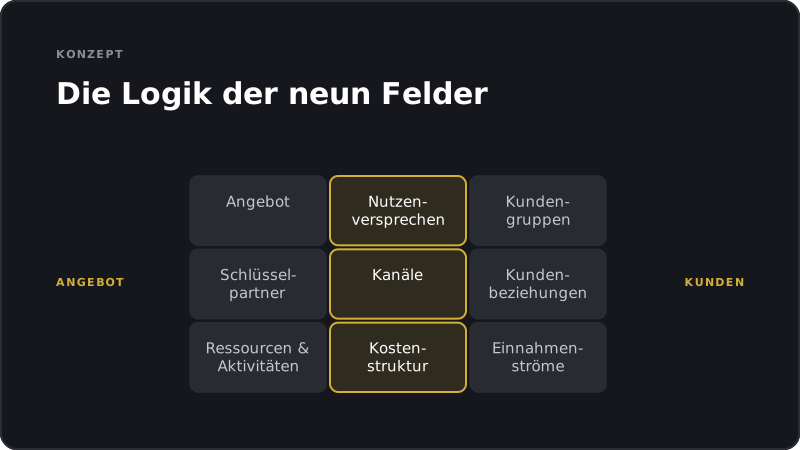
Left and right: offer and customer segments. The foundation of every shop.

  • Center: the value proposition. The bridge between offer and customers.
  • Frame: channels, relationships, revenue, costs, partners, resources, and activities.
Overview of the Nine Fields
Transcript of this slide

The structure follows a clear reading logic that I explain the same way every time. On the left and right, you have the essentials: what do we offer, and which customer segments are we doing this for? In the center is the why: why should these customers buy from us? And around that sit the how fields: how do we reach customers, how do we generate revenue, what does it cost us, who do we work with? Together, they form a complete picture.

Concept

Center: The Value Proposition

The value proposition answers one question: why do these customers buy from me specifically?

  • It's not the product description. It's the concrete benefit to the customer.
  • Everything else in the Canvas relates back to this center.
The Heart of the Canvas
Transcript of this slide

Think of the Canvas like a home. The value proposition is the fireplace everything revolves around. If the promise is vague, the other fields will be vague too. That's why it's worth investing extra time here. A clear promise makes every subsequent decision easier, from product selection to your advertising message.

Concept

Right: Customer Segments

Customer segments aren't demographics. They're people who share a common need and buying behavior.

  • The sharper your segmentation, the more precisely you can choose your channels and communication.
  • Men and women from eighteen to ninety-nine is not a strategy. It's avoidance.
1
Identify needs
2
Build segments
3
Map channels
Transcript of this slide

On the right side are the people you're making your offer for. Many shops make the mistake of thinking too broadly here. Instead of real customer groups, you end up with a diffuse mass. The problem: the broader the target audience, the weaker the marketing. We'll go deeper on this in the next module.

Concept

Left: Offer / Products & Services

The offer describes what you sell: products, services, add-ons.

  • It also includes experiences like consultations, packaging, express shipping, or warranty services.
  • The offer must align with your value proposition and your target audience.
Product plus experience equals offer
Transcript of this slide

On the left side is what you deliver. That's more than the physical product. A gadget shop doesn't just sell a product. It sells discovery, the joy of giving, and that feeling of opening something new. Those experiences are part of the offer, because they're what make the difference.

Concept

Channels: How do you reach your customers?

Channels are all the ways customers hear about you, buy from you, and receive their orders.

  • Examples: your own shop, marketplaces, paid social, SEO, email, phone, direct sales.
  • The choice of channels depends directly on your customer group and their buying behavior.
1
Build reach
2
Spark interest
3
Enable purchase
4
Deliver & support
Transcript of this slide

Channels aren't a matter of taste. It's not enough to say you're on Instagram because everyone else is. The right question is: where does your customer group make decisions, where do they look for solutions, and where are they open to your offer? That's what separates a channel that works from an expensive hobby.

Concept

Customer Relationships: More than a one-time transaction

Customer relationships describe how you interact with customers before, during, and after the purchase.

  • They range from self-service to personal consulting to community management.
  • The goal isn't just the first purchase. It's repeat business and referrals.
One-time purchase vs. long-term relationship
Transcript of this slide

Many shop owners focus too much on the first sale. But a large part of the value lies in the relationship that follows. Why should a customer come back? What keeps them connected? Is there a service, content, an add-on product, or an experience that keeps you top of mind? That's exactly what belongs in this field.

Concept

Revenue Streams: How do you make money?

Revenue streams describe how your shop generates income.

  • Beyond product sales, this can include subscriptions, add-on services, warranties, or business customer contracts.
  • Every stream needs a clearly defined customer group and a matching pricing model.
15 31 46 61 55 Product sales 25 Add-onservices 15 Subscriptions 5 B2B
Typical revenue streams for an e-commerce shop
Transcript of this slide

Revenue rarely comes from a single source. A solid canvas shows you which share each revenue stream contributes. That matters because without it, you don't know where to place your bets. A stream with a small share might have real potential, or it might just be a distraction.

Concept

Cost Structure: What's eating your margin?

Costs can be broken down into fixed, variable, and hidden costs.

  • Typical e-commerce costs: goods, shipping, payment providers, returns, marketing, software, staff.
  • Your cost structure directly affects pricing and scalability.
1
Fixed costs
2
Variable costs
3
Hidden costs
Transcript of this slide

If you only look at revenue, you'll quickly lose track of what actually remains. The cost structure shows you where the money is going. Hidden costs in particular, like returns, payment fees, or lengthy consultation times, are often underestimated. The canvas makes them visible.

Concept

Key Partners: Who do you work with?

Key partners are the suppliers, service providers, platforms, and collaborators your model can't function without.

  • They influence quality, costs, delivery times, and flexibility.
  • Not every supplier is a key partner. Only the ones whose failure would put the business at risk.
Partners as load-bearing pillars
Transcript of this slide

Key partners tend to be underestimated until they're gone. A dropshipper is nothing without their wholesaler. A manufacturer of custom wall decor is stuck without their materials supplier and their craftspeople. The canvas is where you make these dependencies explicit.

Concept

Key Resources & Key Activities

Key resources are everything you need to create your offer: materials, know-how, software, brand rights, capital.

  • Key activities are the recurring tasks that keep the model running.
  • Together, they reveal where your actual value creation lies.
Resources are the what, activities are the doing
Transcript of this slide

These two fields help you understand what you really need to invest in. Resources without activities are dead capital. Activities without resources are wishful thinking. Together, they show you where your strengths are and where you might still have gaps.

Example

Example: Canvas for the dropshipping shop

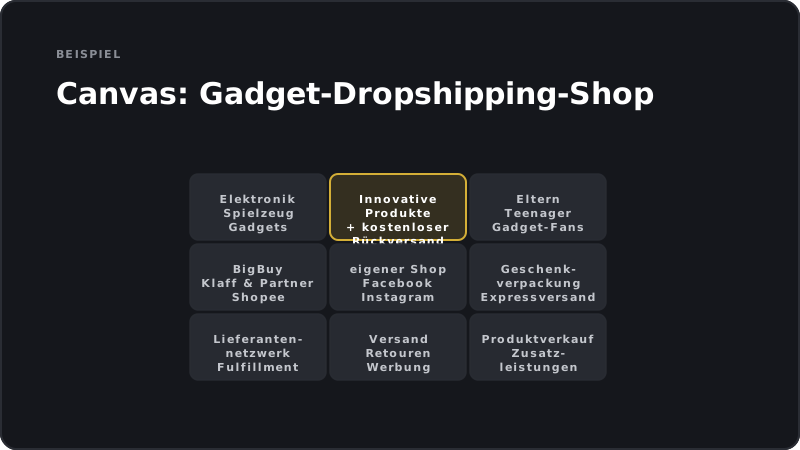
Offer: electronics, lighting, toys, gadgets, plus gift wrapping and express shipping.

  • Customer segments: parents, teenagers, young adults, as gift buyers and gadget enthusiasts.
  • Value proposition: innovative products and free returns.
  • Channels: own shop, Facebook, Instagram. SEO is too slow for this business.
  • Partners: Klaff & Partner, BigBuy, Shopee.
Dropshipping canvas with nine fields
Transcript of this slide

This is a real-world canvas from an actual business. The shop has a clear offer and three defined customer segments. The promise is specific: innovation plus free returns. The channel choices are deliberate. Facebook and Instagram, because SEO would be too slow for this kind of business. And the partners are named because they're what makes the model work.

Example

Example: Canvas for wall décor made from real plants

Offer: letters, symbols, moss pictures, jungle prints, customized for businesses.

  • Customer segments: companies, freelancers, private customers.
  • Value proposition: real plants that stay green forever and need no maintenance.
  • Channels: phone and email are important for advising business clients.
  • Tension: care products could deepen the relationship, or dilute the promise.
B2B and B2C logic in the same canvas
Transcript of this slide

This example shows how different customer segments can coexist in the same canvas. For businesses, phone and email are central because they want personal advice. For private customers, the shop itself may matter more. And the care products question is a great example of how the canvas can surface contradictions.

Exercise

Exercise: three fields for your shop

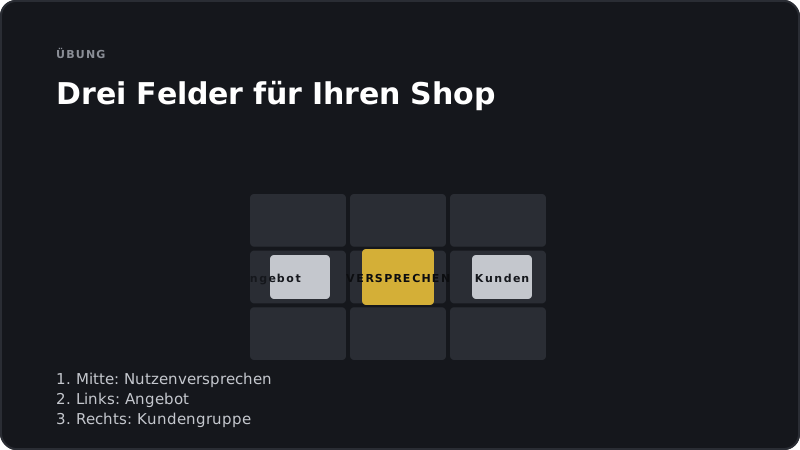
Take a large sheet of paper and draw nine fields.

  • Start with the center: your value proposition.
  • Then the left and right sides: your offer and your most important customer segment.
  • Mark the field you feel least certain about.
Fill in the first three fields yourself
Transcript of this slide

Do this exercise right now. Grab paper and a pen and draw the nine fields. Start with the center, then move left and right. If one field gives you trouble, that's not a coincidence. That's your most important learning point, and exactly where you should look more closely in the upcoming modules.

Common misconception

Misconception: the canvas is a one-time exercise

Wrong: you fill out a canvas once and then put it in a drawer.

  • Right: the canvas is alive. It should be revisited whenever you face an important decision.
  • Right: it's a management tool you feed with real data and adjust over time.
One-time exercise versus a living tool
Transcript of this slide

The biggest mistake with a canvas is treating it like a questionnaire. Fill it in, check the box, forget about it. That throws away all the value. A canvas is only useful when you update it regularly, monthly or even weekly when the market is moving fast. It's your early warning system, not an archive.

Concept

How to read the canvas as a management tool

Always start in the center: does the value proposition still hold?

  • Then check for consistency: are the offer, customer segments, and channels aligned?
  • Finally, look at the numbers: do revenue, costs, and scalability add up?
1
Review the center
2
Check consistency
3
Review the numbers
Transcript of this slide

The canvas only delivers value if you read it correctly. My recommendation: always start in the center with the value proposition. If that's off, everything else is off too. Then look at consistency. Do the offer, customers, and channels fit together? Finally, check the economics. That reading order is what turns the canvas into a real management tool instead of just a nice-looking graphic.

Summary

Summary

The Online Shop Canvas is based on the Business Model Canvas and has been adapted specifically for e-commerce.

  • The nine fields cover offer, customers, value proposition, channels, relationships, revenue, costs, partners, and resources.
  • The center is the value proposition. Every other field relates back to it.
  • A canvas is only valuable if you use it regularly as a management tool.
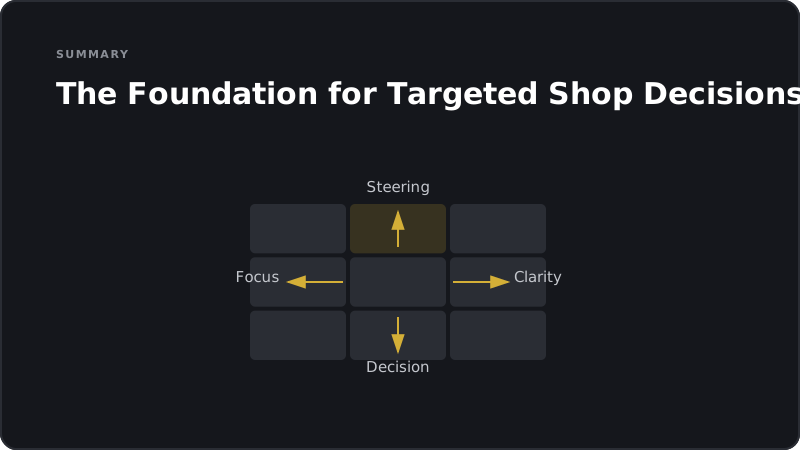
The foundation for focused shop decisions
Transcript of this slide

That wraps up the second module. You now know all nine fields and how they work together. The main takeaway: the value proposition sits at the center, and the canvas only delivers value if you actually use it. In the next module, we go deeper into the right-hand side: customer segments and value propositions. That's where the structure starts to get really sharp.

Quiz

Quiz

Test your knowledge.

A shop owner has filled in all nine fields of their canvas, but the central value proposition remains vague. What is the most likely consequence?

A dropshipping shop for gadgets deliberately chooses Facebook and Instagram over SEO. Which canvas logic best explains this choice?

Which assignment correctly places the fields in the Online Shop Canvas?

A moss wall provider serving both businesses and private customers spots a tension in their canvas: the promise is 'zero maintenance,' yet they also want to sell care products. What is the right conclusion?

A shop has monthly fixed costs of five thousand euros and variable costs of forty percent of revenue. At what revenue does it reach break-even?

Exercise

Exercise

Apply what you have learned right away.

  • 1
    Nine-field canvas for your own shop
    canvas · approx. 25 min
  • 2
    Canvas consistency check
    audit · approx. 15 min
Reflection

Reflection

A quick look back before you continue.

  • Which of the nine fields is currently the weakest in your business model, and what effect does that have on the other fields?
  • Where do you currently see a contradiction between your value proposition, your most important customer segment, and your choice of channels?
  • Which hidden costs, such as returns, payment fees, and lengthy consultation time, are you most likely underestimating in your cost structure?
Finish

Module completed

Next module: Customer segments & value propositions

Hands-on material to take away

This module comes with two PDF downloads you can apply right away:

  • Job-Aid: The core message condensed onto one page, ideal for quick reference before decisions.
  • Worksheet: A fillable worksheet to adapt what you have learned to your shop.

Overview & learning objective

This module is aimed at shop owners.

After completing this module, you'll be able to map your business model across the nine fields of the Online Shop Canvas, with the value proposition at the center, and use the Canvas as a management tool by checking every initiative against the field it affects and making sure your offer, customer segments, and channels all fit together consistently.

Prerequisites: Why a Business Model Needs to Survive Today
The Online Shop Canvas: The Nine Fields