JDKRUEGER&COAcademySign inDE
Module 1 of 5 · eCommerce Fundamentals

Why a Business Model Needs to Survive Today

⏱ 30 min · After completing this module, you'll be able to explain why static three-year business plans fail as a management tool in the volatile, uncertain world of e-commerce (VUCA), and you'll use the Online Shop Canvas as a living document you can quickly adapt when the market shifts, rather than clinging to outdated assumptions.
← eCommerce Fundamentals Why a Business Model Needs to Survive Today 1 / 26
continuing in 5
Start

Why a Business Model Needs to Survive Today

The market changes faster than your business plan. A canvas gives you clarity and the speed to adapt.

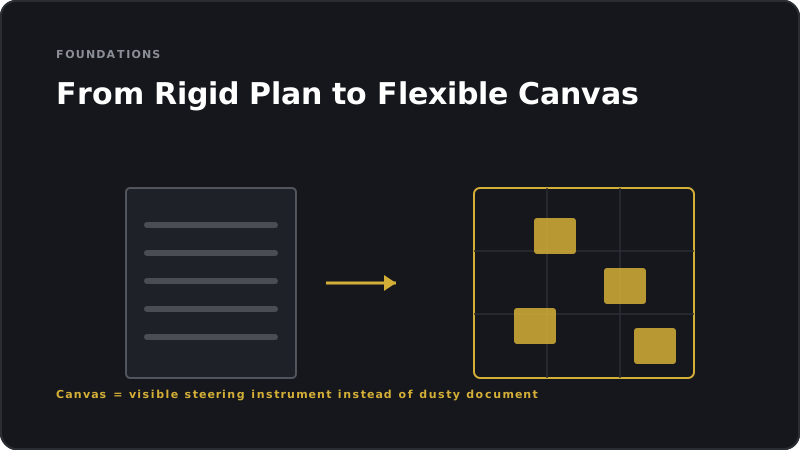
From Rigid Plan to Flexible Canvas
Transcript of this slide

Welcome to the first module of the eCommerce Fundamentals course. I want to give you a quick introduction to an idea I'm genuinely passionate about: the Online Shop Canvas. It builds on the Business Model Canvas that many of you already know, and it's actually quite straightforward. It helps us tackle exactly the questions that matter day to day: What's our USP? What do we want to sell? Why do people buy from us? We live in a VUCA world: volatile, uncertain, complex, ambiguous. Once you internalize that, you understand why a rigid document no longer cuts it and why a canvas on the wall is so much closer to reality. Because a canvas isn't a filing folder. It's a working tool.

Learning objective

What You'll Learn in This Module

You'll recognize why classic business plans hit their limits in e-commerce.

  • You'll understand the VUCA world and what it means for your shop.
  • You'll see the difference between a static plan and a flexible canvas.
1
Recognizing business plan pitfalls
2
Understanding VUCA
3
Applying Canvas logic
Transcript of this slide

After this module, you'll look at your planning differently. You'll know why three-year plans are wishful thinking in many cases, and you'll understand why successful shop owners prefer working with a canvas they can update at any time. That's the foundation for everything that comes in the next modules.

Self-check

Quick Self-Check

Do you have a written business plan for your shop?

  • When did you last update it in response to a market shift?
  • Could you explain your business model in three sentences?
Three Questions About Your Planning
Transcript of this slide

Before we get started, take a moment for a quick self-assessment. There's no right or wrong here, just an honest look at where things stand. If your business plan is sitting in a drawer while the market has shifted three times since you wrote it, you're far from alone. That's exactly the starting point we're building from.

What this means for you

What Does This Mean for Your Shop?

Every decision about your product range, pricing, and marketing depends on a clear business model.

  • Without that compass, you're spreading your budget, time, and energy too thin.
  • A solid business model makes it immediately clear where you're placing your bets and what you're consciously choosing not to do.
With a model: focus. Without a model: scatter.
Transcript of this slide

The practical benefit for you as a shop decision-maker is enormous. When you have a clear business model, you can say no to things that don't fit. Without one, you jump from tactic to tactic and wonder why nothing ever really clicks. That's exactly the clarity we're going to build over the next few hours.

Concept

The Classic Business Plan: A Document for More Stable Times

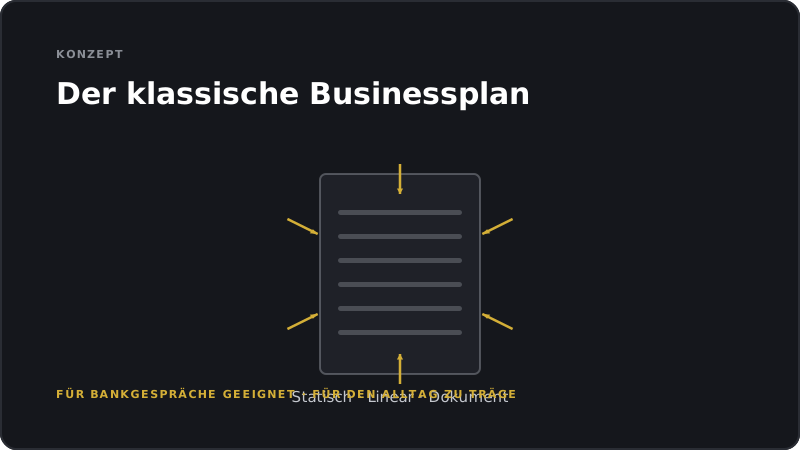
The classic business plan was written for bank meetings and investors, not for fast operational decisions.

  • It's based on assumptions that often stop holding up after just a few months, especially in e-commerce.
  • It tends to document what you believe rather than what you learn from data every day.
Static Plan vs. Moving Market
Transcript of this slide

The business plan isn't the enemy. It has its place when it comes to securing financing. But it's a document for outsiders, not a day-to-day management tool. When your supply chain, your customers, or your ad costs can shift within weeks, a document from last year isn't much help. That's exactly why we need something faster.

Concept

VUCA: The World We Work In

V = Volatile: markets change suddenly and unpredictably.

  • U = Uncertain: we can no longer reliably forecast long-term developments.
  • C = Complex: many factors are acting on each other at the same time.
  • A = Ambiguous: data and events can be interpreted in more than one way.
1
Volatile
2
Uncertain
3
Complex
4
Ambiguous
Transcript of this slide

VUCA isn't a theoretical buzzword. It's a pretty accurate description of what we actually experience in e-commerce. I sometimes call it the VUCA world in everyday conversation, and that's exactly what it means: volatile, uncertain, complex, ambiguous. A new data privacy regulation, an algorithm update, a supplier problem, a sudden trend, and any of these can knock yesterday's assumptions off the table. If you respond with a rigid plan, you lose. If you have a canvas, you can pivot early. That's why we need to move away from thinking about things as static, set-in-stone plans and toward a tool that lets us respond to change quickly and cut through complexity.

Example

Example: The Summer When Everything Changed

An outdoor shop planned its season in spring based on historical growth rates.

  • Extreme weather and rising energy costs shifted demand in certain categories by forty percent.
  • Shops with a flexible canvas were able to shift their product range and messaging within two weeks. Everyone else was still selling old stock.
39 77 116 154 100 Plan 140 Canvas shops 78 Plan shops
Relative revenue development after an external shock
Transcript of this slide

This example shows the practical difference. Both sides had good intentions. But the shop with the flexible business model could quickly ask: Which customer group is shifting? What offer fits right now? Which channels are still profitable? The other shop kept working through its original plan and lost valuable weeks in the process.

Concept

What exactly is a business model?

A business model describes how a company creates, delivers, and captures value.

  • It answers: For whom are we solving which problem? How do we reach those customers? And how do we make money doing it?
  • In e-commerce, that also means: Which products, channels, costs, and relationships make the shop profitable?
1
Creating value
2
Communicating value
3
Capturing value
Transcript of this slide

Before we get into the details, let's clarify the terminology. A business model is not a vision, a mission, or a marketing tagline. It's the answer to the question of how your shop actually works. If you're clear on that, you can invest with purpose. If you're not, you end up investing in symptoms rather than causes.

Concept

Plan versus canvas: two different worlds

A plan is linear, static, and written around a fixed set of assumptions.

  • A canvas is visual, modular, and built for experimentation.
  • A plan gets worked through; a canvas gets continuously questioned.
Plan: linear. Canvas: modular.
Transcript of this slide

The difference sounds theoretical, but it's enormous in practice. A plan tells you what to do. A canvas keeps asking you: Does this still make sense? What has changed? Which scenario would work better? That ability to keep questioning is exactly what we need in uncertain markets.

Concept

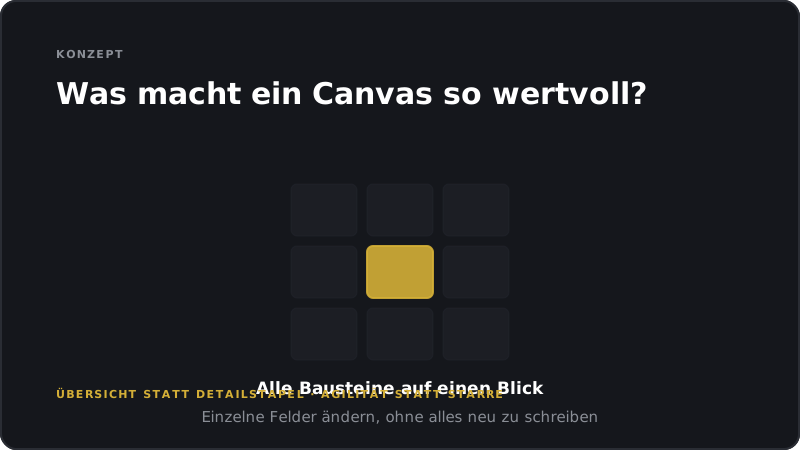
What makes a canvas so valuable?

You see all the key building blocks of your business at a glance, like a poster on the wall.

  • You can change individual fields without rewriting the entire document.
  • You can run through scenarios before committing any budget.
All building blocks at a glance
Transcript of this slide

Imagine pinning your entire business model to the wall as a large poster. Every field is a sticky note. When something changes, you move a sticky note, not the whole bookshelf. That's the idea behind the canvas: something you can rewrite at any time. Overview instead of stacks of detail, agility instead of rigidity. Because a canvas is a canvas, not a plan. It's something you hang on the wall where you can use sticky notes to decide very quickly what you have and what you want to change.

Your instructor

My perspective

I developed the Online Shop Canvas because traditional plans stopped working for me in day-to-day practice.

  • It forces me to get to the point, while still staying flexible.
  • It helps me quickly spot which assumptions still hold and which ones I need to revisit.
A personal through-line
Transcript of this slide

Personally, I don't enjoy working with thick documents that are outdated within three months. What matters to me is what's working today and what could be better tomorrow. So for me, the canvas isn't a theoretical model. It's a working tool I use with clients and in my own projects. It's based on the Business Model Canvas by Strategyzer and Business Model Foundry, but it's specifically shaped around the questions that actually matter to online shops. And that simplicity is what forces us to get straight to the point.

Concept

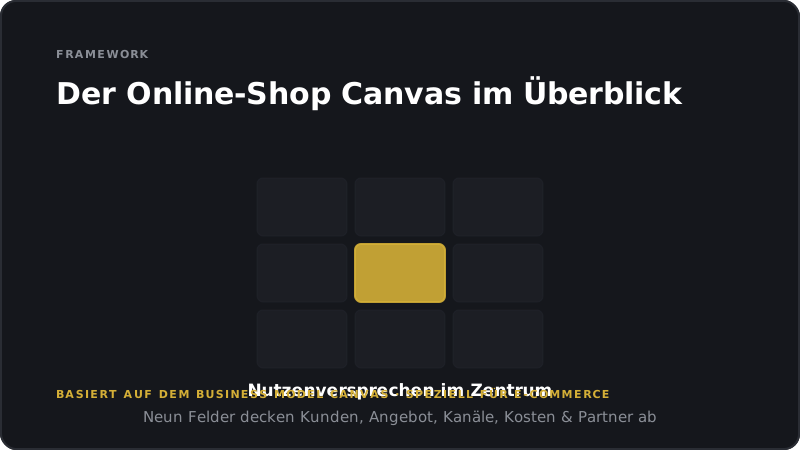
The Online Shop Canvas: an overview

It's based on the proven Business Model Canvas and adapted specifically for e-commerce.

  • Nine fields cover customers, offer, channels, relationships, revenue, costs, and partners.
  • At the center is your value proposition, the answer to why customers buy from you.
The nine fields of the Online Shop Canvas
Transcript of this slide

In the next module, we'll walk through all nine fields step by step. Here's the rough map for now: the value proposition sits in the center. Customers and offer are to the left and right. Surrounding them are channels, relationships, revenue, costs, partners, resources, and activities. We'll fill in this structure together over the next few sessions. You'll see it's less complex than it looks at first glance.

Example

Example: a dropshipping shop for gadgets

Customer segments: parents, teenagers, and young adults, as gift buyers and gadget enthusiasts.

  • Value proposition: innovative products and free returns.
  • Channels: Meta and Instagram, because SEO is too slow here.
1
Defining customer segments
2
Formulating the value proposition
3
Choosing the right channels
Transcript of this slide

Here's a real-world example. The shop doesn't sell products to everyone between eighteen and ninety-nine. It focuses on clear customer segments with a shared need. The value proposition is equally concrete: innovative products plus free returns. And the channel choice is deliberate, not accidental. That's how clarity is built.

Example

Example: wall decor made from real plants

Customers: businesses, freelancers, and private clients looking for custom décor.

  • Value proposition: Real plants that stay green forever and require zero maintenance.
  • Key insight: Phone and email are important sales channels because businesses want personalized consultation.
B2B and B2C customers in the same canvas
Transcript of this slide

This example shows how apparently contradictory elements can coexist in a single canvas. The provider serves both businesses and private customers. That only works because each group gets the right promise and the right channel. Without that differentiation, the messaging blurs and conversions suffer.

Exercise

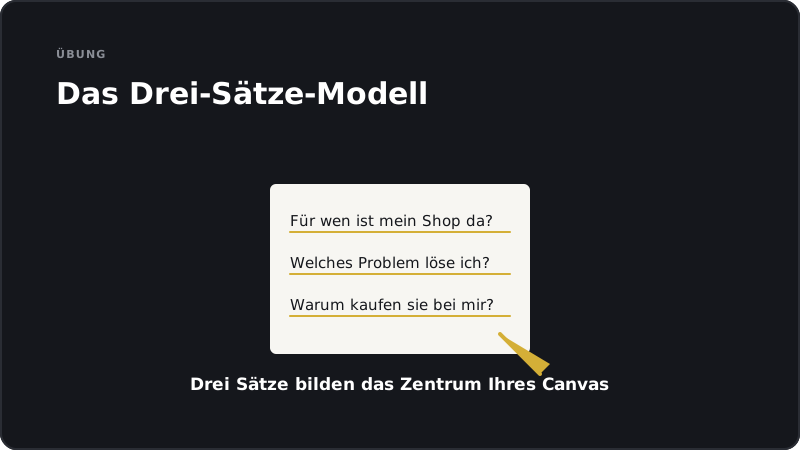
Your first exercise: the three-sentence model

Grab a sheet of paper and write three sentences:

  • Sentence one: Who is my shop for?
  • Sentence two: What problem am I solving for these customers?
  • Sentence three: Why do they buy from me specifically?
Three sentences, a first model
Transcript of this slide

Do this exercise right now, even if it sounds simple. Most shop owners can't phrase their answers as concisely as they think they can. That's exactly where the value lies. Once you have those three sentences, you already have a rough draft for the center of your canvas. We'll build everything else around it in the upcoming modules.

Common misconception

Common misconception: a canvas replaces strategy

Wrong: a canvas is not a strategy. It's a tool for documenting and testing your strategic assumptions.

  • Right: it helps you spot contradictions and correct them quickly.
  • Right: it only works if you update it regularly and validate it against real data.
Canvas as a management tool, not a strategy substitute
Transcript of this slide

There's a widespread misconception here: you fill in the canvas once and suddenly you have a strategy. That's not the point. The canvas is a management tool that makes your strategy visible. When your assumptions turn out to be wrong, you update the canvas. You don't ignore reality.

Scenario

Scenario: two shop owners compared

Maria updates her canvas every month and spots early on that one customer segment is no longer profitable.

  • Tom works through his annual plan and only realizes after six months that his cost structure no longer holds up.
  • Maria can pivot faster; Tom is tying up budget in an outdated assumption.
36 72 107 143 100 Q1 108 Q2 118 Q3 130 Q4
Flexibility beats rigidity
Transcript of this slide

This scenario plays out every day. Maria doesn't win because she's smarter. She wins because she sees change coming earlier. Her canvas forces her to keep asking the right questions. Tom is in the same market, but his plan gives him no early-warning system. The difference is in the system, not the talent.

Interim check

Halfway checkpoint

Business plans are useful for financing conversations, but they fall short as a management tool.

  • VUCA describes reality: volatile, uncertain, complex, ambiguous.
  • A canvas makes your business model visible, open to questioning, and easy to adapt.
1
Business plans have limits
2
VUCA is reality
3
Canvas creates clarity
Transcript of this slide

Let's pause for a moment. The three key takeaways from the first half: plans have limits, the market is volatile and complex, and the canvas is the better management tool. Once you've internalized that, the rest of the course is really just application.

Concept

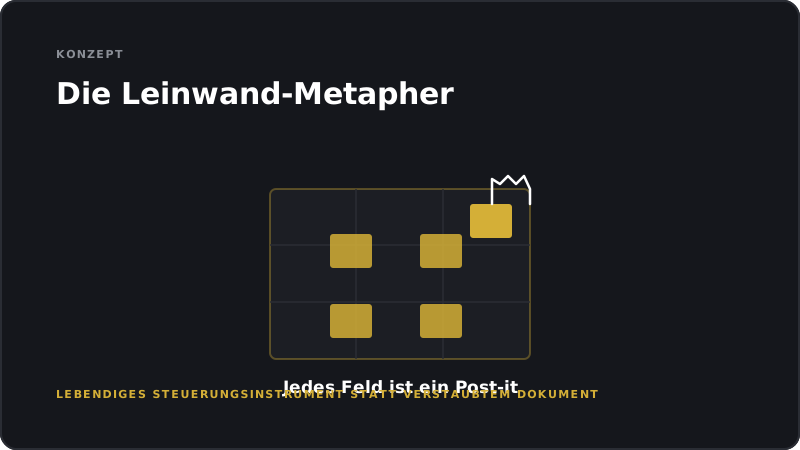
The canvas metaphor: your canvas on the wall

A canvas isn't a file sitting in a drawer. It's a canvas hanging on your wall.

  • Every field is a sticky note you can move, replace, or add to.
  • That's how you create a living management tool rather than a dusty document.
Canvas as a wall of movable sticky notes
Transcript of this slide

The key difference between a plan and a canvas is easy to picture. A plan often ends up in a drawer. A canvas hangs on the wall. Every field is a sticky note. When something changes, you peel one off and stick a new one on. That sounds simple, but that's exactly where the power lies: your business model stays visible, open to questioning, and easy to adapt. Nothing should be allowed to change without you noticing.

Concept

What the canvas saves you in day-to-day work

Fewer arguments based on gut feeling, because assumptions are out in the open.

  • Less scattered budget, because it's clear which levers actually matter.
  • Fewer surprises, because you spot changes early across the different fields.
Before: guessing. After: deciding.
Transcript of this slide

The practical benefit is easy to describe. Before the canvas, the loudest voice in the room or the last conference you attended often drove decisions. After the canvas, you decide based on clear assumptions. That saves time and prevents costly mistakes. It's exactly what makes the canvas indispensable to me.

Summary

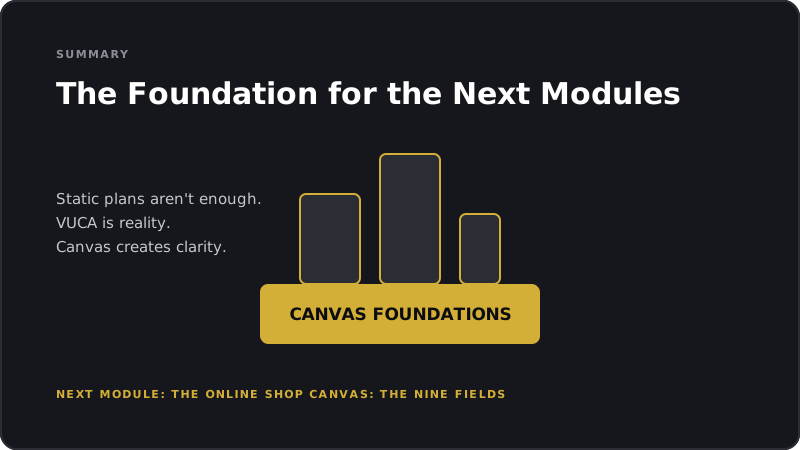
Summary

Traditional business plans are too static for today's e-commerce world.

  • VUCA explains why plans become outdated so quickly.
  • A canvas is a living document that creates clarity and the ability to adapt quickly.
The foundation for the modules ahead
Transcript of this slide

That wraps up the first module. We've covered why a business model needs to stay agile today, because the market moves faster than any rigid plan ever can. In the next module, we'll take a close look at the Online Shop Canvas in detail and walk through all nine fields. That's where the idea becomes a concrete tool you can put to work in your shop.

Quiz

Quiz

Test your knowledge.

An outdoor shop notices that demand for a product category drops by forty percent within four weeks. Which response best fits the Canvas logic?

What is the key distinction between a traditional business plan and a Canvas?

A shop owner says: "I've filled out my Canvas, so now I have my strategy." What's wrong with that statement?

Which of the following scenarios best describes VUCA?

During the three-sentence exercise, a shop owner realizes that the question "Why do they buy from me specifically?" is the hardest one to answer. What is the most likely reason?

Exercise

Exercise

Apply what you have learned right away.

  • 1
    The three-sentence model
    worksheet · approx. 12 min
  • 2
    VUCA check for your market
    audit · approx. 15 min
Reflection

Reflection

A quick look back before you continue.

  • Which assumption in your current business model is most likely to be wrong, and what signal would tell you early enough to pivot?
  • How quickly could your shop respond today to a sudden market shock, like an algorithm update or a supplier failure, and which lever would you pull first?
  • Which field of your business model would you put on the canvas first, because that's where the most uncertainty lives right now?

Overview & learning objective

This module is aimed at shop owners.

After completing this module, you'll be able to explain why static three-year business plans fail as a management tool in the volatile, uncertain world of e-commerce (VUCA), and you'll use the Online Shop Canvas as a living document you can quickly adapt when the market shifts, rather than clinging to outdated assumptions.

Why a Business Model Needs to Survive Today