JDKRUEGER&COAcademySign inDE
Module 1 of 4 · CRO & GDPR

GDPR as a CRO Competitive Advantage

⏱ 25 min · After completing this module, you'll be able to build GDPR-compliant CRO in the DACH region as a genuine competitive advantage: you'll use the three pillars of legal basis, data minimization, and transparency as trust drivers, account for the differences between Germany, Austria, and Switzerland, and recognize that clean compliance strengthens trust, data quality, and scalability rather than holding CRO back.
← CRO & GDPR GDPR as a CRO Competitive Advantage 1 / 23
continuing in 5
Start

GDPR as a CRO Competitive Advantage

Why data privacy in the DACH market can be a driver of trust and conversion rather than a barrier.

GDPR-Compliant CRO as a Competitive Advantage
Transcript of this slide

Welcome to the GDPR track. Data privacy is often seen as a tedious obligation. In this module, you'll learn why a solid GDPR strategy is a genuine competitive advantage in the DACH market, especially when it comes to CRO.

Learning objective

Learning Objective

You'll understand the economic significance of GDPR-compliant CRO.

  • You'll recognize the differences between Germany, Austria, and Switzerland.
  • You'll be able to define requirements for consent, tracking, and testing infrastructure.
1
Understanding the Economics
2
Knowing the DACH Differences
3
Setting Requirements
Transcript of this slide

After this module, you'll no longer see data privacy as a purely legal topic, but as a strategic part of your CRO system. That's especially relevant in the DACH market.

Concept

Why GDPR Affects CRO

CRO runs on data: how users behave, what they buy, which variants win.

  • Without a legally sound data foundation, your analyses and tests are at risk.
  • A cease-and-desist letter or a consent disaster can get expensive faster than a lost test.
Data-Driven CRO Requires Legally Sound Data
Transcript of this slide

CRO without data doesn't work. But data without legal certainty is risky. That's why GDPR isn't a side topic; it's a prerequisite for sustainable, scalable CRO.

Concept

The Trust Factor

Users in the DACH market are more privacy-conscious than in many other markets.

  • A transparent consent experience signals: this shop respects me.
  • Trust reduces friction, and that can have a positive impact on conversion.
1
Transparency
2
Trust
3
Less Friction
4
More Conversion
Transcript of this slide

When users feel your shop handles their data fairly, they're more willing to take steps that lead to conversion, like making a purchase or signing up.

Example

Example: The Consent Banner Test

A shop tests two consent banners: one small and hidden, one clear and informative.

  • Banner A leads to more tracking consent, but also more complaints.
  • Banner B leads to slightly less consent, but higher trust and stable conversion rates.
Short-Term Tracking Rate vs. Long-Term Trust
Transcript of this slide

This example shows the conflict. Short-term, an aggressive banner may generate more tracking consent. Long-term, it damages trust and raises your risk profile. CRO has to account for both.

Concept

DACH Is Not One Market

Germany: TTDSG plus GDPR, strict approach to tracking cookies and consent.

  • Austria: EU GDPR with its own administrative penalties, a very active data protection authority.
  • Switzerland: New Data Protection Act (nDSG), not EU GDPR, but similar requirements.
Germany, Austria, and Switzerland Compared
Transcript of this slide

Anyone operating in the DACH region needs to understand these differences. A setup that works in Germany isn't automatically sufficient in Austria or Switzerland. That's the DACH differentiator.

Concept

The Three Pillars of GDPR-Compliant CRO

Pillar one: legal basis. What grounds do you have for tracking and testing?

  • Pillar two: data minimization. What data do you actually need?
  • Pillar three: transparency and control. How do you inform users, and how can they object?
1
Legal Basis
2
Data Minimization
3
Transparency
Transcript of this slide

These three pillars form the foundation. Taking them seriously doesn't just build compliance; it builds a lasting relationship of trust with your customers.

Scenario

Scenario: The Competitor With the Sloppy Setup

A competitor is clearly tracking without proper consent and appears to have more data in the short term.

  • But when an audit happens or a major data scandal breaks, they lose traffic, trust, and budget.
  • Your clean setup pays off in the long run, through stability and reduced risk.
Short-Term Advantage vs. Long-Term Stability
Transcript of this slide

It can be frustrating when competitors seem to play by looser rules. But CRO is a long-term game. Those who build a clean foundation today face less risk tomorrow and often come out with a stronger brand image.

Concept

Consent Mode and Conversion Modeling

Google Consent Mode lets you receive modeled data even without user consent.

  • This closes data gaps and keeps CRO decisions grounded in a valid foundation.
  • That said, Consent Mode doesn't replace a legally sound consent solution.
1
Consent
2
Consent Mode
3
Modeled Data
Transcript of this slide

Consent Mode is a technical tool that bridges the gap when users don't consent. It's not a free pass, but it is an important building block for privacy-compliant tracking.

Concept

What Decision-Makers Should Expect From Their Team

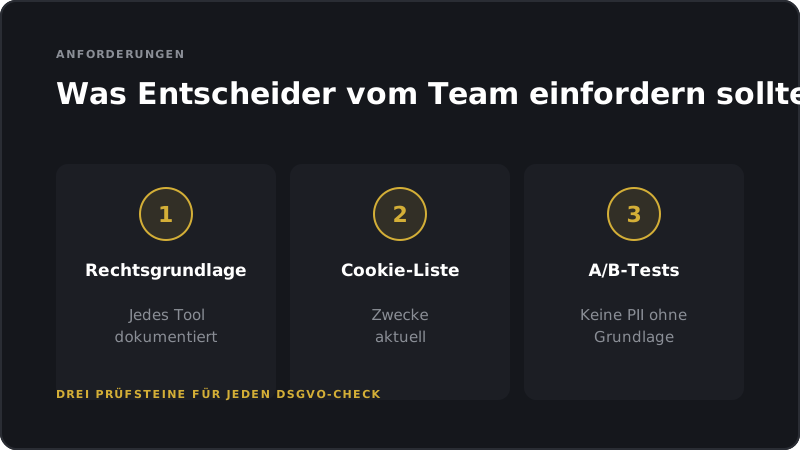
A documented legal basis for every tracking and testing tool.

  • A current list of all cookies and their purposes.
  • Proof that A/B tests do not store personal data without a legal basis.
Three GDPR Requirements for CRO Decision-Makers
Transcript of this slide

These three requirements belong in every GDPR check for CRO. They're not particularly technical, but they reveal whether your setup is mature or whether gaps still exist.

Exercise

Exercise: Your GDPR CRO Score

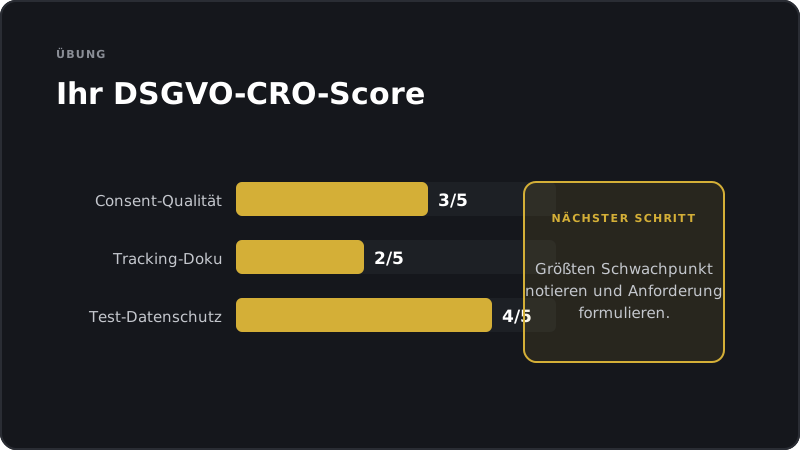
Rate your current setup on a scale of one to five for: consent quality, tracking documentation, and test data privacy.

  • Write down your biggest weak point.
  • Define a concrete requirement for your team or your agency.
Assessing Your GDPR CRO Maturity Level
Transcript of this slide

This score brings clarity and gives you a concrete first lever to pull.

Concept

GDPR-Compliant A/B Testing

A/B tests often store variant assignments and events.

  • As long as no personal data is processed without a legal basis, tests are permitted.
  • Important: transparency in your privacy policy and a working right to object.
1
Variant Assignment
2
No PII
3
Transparency
Transcript of this slide

The key is separation: test control is fine, but personal data without a legal basis is not.

Example

Case Study: The DACH Differentiator

A Europe-wide shop optimizes its consent experience for the EU average only.

  • In German-speaking markets, this leads to lower consent rates and compliance risks.
  • A DACH-specific consent flow with clear information and easy controls raises both consent and trust.
EU Average vs. DACH-Specific Consent Flow
Transcript of this slide

When you do that, you gain more than compliance; you usually gain better data too.

Common misconception

Myth: "GDPR Makes CRO Impossible"

Fact: GDPR doesn't limit CRO, it demands cleaner data practices.

  • Taking privacy seriously often leads to higher tracking quality.
  • Consent-respecting tests can deliver valid results.
Restriction vs. Quality Driver
Transcript of this slide

This myth is widespread. GDPR doesn't mean less CRO, it means different CRO. Those who know the rules can test and optimize very successfully within them.

Concept

Long-Term Benefits of a Clean Setup

Less risk of cease-and-desist letters and fines.

  • Greater acceptance among privacy-conscious customers.
  • A more stable data foundation for AI-driven analytics and personalization.
1
Less Risk
2
More Trust
3
Better Data
Transcript of this slide

The benefits of clean data protection play out over the long term. They affect compliance, customer relationships, and data quality. That makes it strategically relevant.

Summary

Summary

GDPR-compliant CRO is a competitive advantage in the DACH region.

  • Germany, Austria, and Switzerland each have different areas of emphasis.
  • Consent, data minimization, and transparency are the three pillars.
1
Competitive Advantage
2
DACH Differentiation
3
Three Pillars
Transcript of this slide

The core argument: GDPR isn't a roadblock, it's a driver of quality and trust. Understanding this early means building a more sustainable, lower-risk CRO system.

Summary

Your Key Takeaways

Check whether your consent setup is optimized specifically for DACH.

  • Request documentation of all tracking and testing tools.
  • Connect your GDPR investments to trust and long-term data quality.
From Compliance to Competitive Advantage
Transcript of this slide

GDPR becomes a competitive advantage when you treat it as a trust and quality lever, not just a compliance checkbox.

Intermediate step

Outlook

The next module covers consent management and conversion tracking: how to design consent in a way that strengthens both data quality and conversion.

Next Module: Consent Management
Transcript of this slide

In the next module, we'll go deeper on consent management. Because the consent banner is often the very first real touchpoint in data privacy, and that makes it an important conversion factor too.

Quiz

Quiz

Test your knowledge.

Why can data privacy be a competitive advantage in CRO?

Which legal bases are relevant for privacy-compliant tracking?

What do you need to keep in mind when differentiating across the DACH region?

Who is generally responsible for ensuring that tracking is implemented in a privacy-compliant way?

What risk arises from non-compliant CRO tracking?

Exercise

Exercise

Apply what you have learned right away.

  • 1
    DACH Compliance Check
    checklist · approx. 25 min
    For Germany, Austria, and Switzerland, check each market individually: What specific requirements apply to your shop? Note where your current setup would need to be adjusted to be fully compliant across all three markets.
  • 2
    Evaluate Your Consent Experience
    audit · approx. 15 min
    Open your own shop in a private browsing window. Rate your consent banner on clarity, ease of control, and visual trustworthiness. Write down three areas for improvement.
Reflection

Reflection

A quick look back before you continue.

  • How would you explain to a customer in one sentence why you're using a particular tracking tool - and does that explanation actually convince them?
  • Which compliance risk in your current CRO setup are you most likely pushing aside because properly addressing it would be uncomfortable?
  • At which specific touchpoint could you actively communicate your GDPR compliance as a visible trust advantage, rather than simply meeting the requirement without saying a word?
Sources

Sources & further reading

Here you will find links and materials to explore the topic in more depth. Take your time.

Overview & learning objective

This module is aimed at shop owners.

After completing this module, you'll be able to build GDPR-compliant CRO in the DACH region as a genuine competitive advantage: you'll use the three pillars of legal basis, data minimization, and transparency as trust drivers, account for the differences between Germany, Austria, and Switzerland, and recognize that clean compliance strengthens trust, data quality, and scalability rather than holding CRO back.

GDPR as a CRO Competitive Advantage