JDKRUEGER&COAcademySign inDE
Module 2 of 4 · CRO & GDPR

Consent Management and Conversion Tracking

⏱ 25 min · After completing this module, you'll be able to treat your consent banner as a conversion touchpoint you can actively shape: you'll evaluate it based on clarity, control, friction, and trust, understand the connection between transparent design, consent rate, and data quality, and place Google Consent Mode in the right context - as a complement to a clean consent solution, not a replacement for one.
← CRO & GDPR Consent Management and Conversion Tracking 1 / 23
continuing in 5
Start

Consent Management and Conversion Tracking

How to design consent so that data privacy, data quality, and conversion grow together.

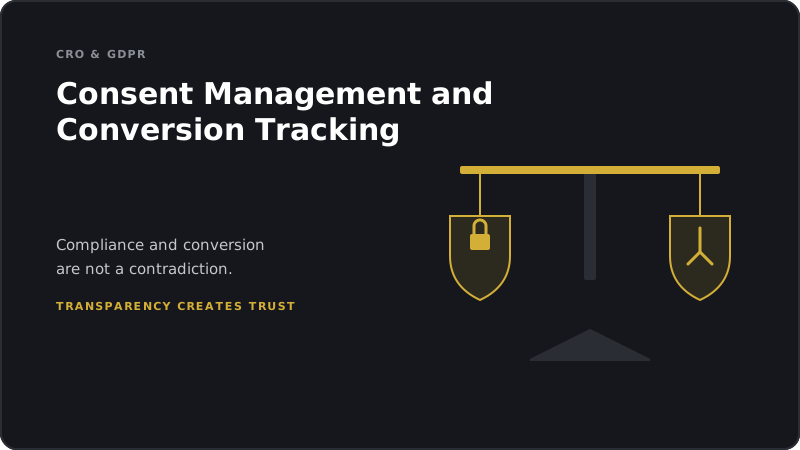
Consent as a Balancing Act Between Compliance and Conversion
Transcript of this slide

Welcome to the second module of the GDPR track. The consent banner is often the first real privacy touchpoint your visitors encounter, which also makes it a conversion factor. In this module, you'll learn how to bring both together.

Learning objective

Learning Objective

You understand the economic impact of a consent banner.

  • You know the most important consent design principles.
  • You can define the requirements for GDPR-compliant conversion tracking.
1
Understanding the Business Case
2
Design Principles
3
Setting Requirements
Transcript of this slide

After this module, you'll no longer see the consent banner as just a legal obligation. You'll see it as a touchpoint you can shape, one that influences opt-in rates, data quality, and trust.

Concept

Why the Consent Banner Is a Conversion Factor

The banner is often the first interaction a visitor has with your shop.

  • A confusing banner creates mistrust and can cause visitors to leave immediately.
  • A transparent banner builds trust and increases willingness to consent.
Banner Design Influences Trust and Consent
Transcript of this slide

Many shops underestimate the psychological effect of the consent banner. It's not just a small technical pop-up. It's the first moment you communicate with your visitor.

Concept

The Two Goals of a Good Consent Banner

Legal goal: informed, voluntary, and revocable consent.

  • Business goal: the highest possible opt-in rate, achieved through genuine transparency.
  • Both goals matter equally. One without the other is neither compliant nor sustainable.
1
Legal Compliance
2
High Consent Rate
Transcript of this slide

The conflict between compliance and conversion is a false one. A well-designed banner can achieve both. Being genuinely transparent often wins more consent than trying to be clever about it.

Example

Example: The Difference Between Accepting and Declining

Banner A shows two equally sized buttons: "Accept all" and "Decline."

  • Banner B hides the decline option behind a "Settings" link.
  • Banner A has a lower opt-in rate, but higher trust and fewer complaints.
Equal Choice vs. Hidden Decline
Transcript of this slide

This example reveals the real trade-off. A banner that hides the decline option may generate more consent in the short term. Long term, it damages trust and your brand image.

Concept

Consent Design Principles

Clarity: what is being tracked and why?

  • Control: the user can easily accept, decline, or make granular choices.
  • Low friction: the dialog doesn't interrupt the visit more than necessary.
  • Trust: the design fits your brand and doesn't look suspicious.
1
Clarity
2
Control
3
Low Friction
4
Trust
Transcript of this slide

These four principles are the benchmark for good consent design. Each one has both legal and business dimensions. Keep all four in mind.

Scenario

Scenario: The Aggressive Banner

A shop displays a banner that covers the entire page and only disappears after several clicks.

  • The opt-in rate is high, but the bounce rate rises too.
  • Visitors leave the page before they even see a product.
High Consent, High Bounce
Transcript of this slide

This scenario shows that a high opt-in rate isn't the only goal. If the banner destroys the user experience, you lose potential customers. The balance is what matters.

Concept

Google Consent Mode at a Glance

Consent Mode adjusts the behavior of Google tags based on the user's consent.

  • With consent: full tracking.
  • Without consent: modeled, aggregated data instead of personal data.
1
Consent
2
Full Tracking
3
Rejection
4
Modeled Data
Transcript of this slide

Consent Mode is an important technical tool. It closes the data gap that occurs when users decline. But it doesn't replace a solid consent solution. It complements it.

Concept

Consent and Conversion Tracking Quality

The higher the opt-in rate, the more real conversion data you have to work with.

  • The lower the opt-in rate, the more you'll need to rely on modeled data.
  • A good consent flow doesn't just maximize compliance. It maximizes data quality too.
24 47 71 94 40 Q1 55 Q2 70 Q3 85 Q4
Transcript of this slide

This connection is what really matters. A better consent experience leads to more opt-ins, more real data, and better CRO decisions. That's the business case.

Exercise

Exercise: Your Consent Banner Audit

Open your shop in a private browsing window.

  • Rate your banner on clarity, control, friction, and trust.
  • Write down three concrete areas for improvement.
Evaluate your own consent banner
Transcript of this slide

This exercise is very hands-on. Many shop owners never see their own banner because they never browse in incognito mode. Do it now. It's worth it.

Concept

What decision-makers should require from their team

A documented consent strategy with a target opt-in rate.

  • An overview of all tools that require consent.
  • A test plan for consent banner variants.
1
Strategy
2
Tool Overview
3
Test Plan
Transcript of this slide

These three requirements make consent management controllable. Without a strategy, it stays reactive. Without a clear tool overview, gaps appear. Without a test plan, you miss optimization potential.

Example

Case study: The DACH consent test

A shop tested two banners in Germany: one using a dark pattern, one offering a clear and simple choice.

  • The transparent banner had ten percent less consent, but five percent less bounce and higher trust.
  • Over time, the transparent banner led to more stable conversion rates.
Short-term consent vs. long-term conversion
Transcript of this slide

This case study shows the long-term effect. Short-term opt-in rates aren't everything. When users feel manipulated, they're more likely to leave the page or never come back.

Common misconception

Misconception: "Consent banners should be as small as possible"

Fact: A banner needs to inform before it asks for consent.

  • Banners that are too small or hidden can create legal problems.
  • The art is in the balance: clear, but not intrusive.
Visibility vs. distraction
Transcript of this slide

A tiny banner may seem less disruptive, but it often fails to meet the legal obligation to inform. On the other hand, a banner that dominates the page creates its own problems. The balance matters.

Concept

Conversion tracking without consent

Not everything that's technically possible is legally permitted.

  • Tracking before consent is not allowed in most cases within the DACH region.
  • Server-side tracking and Consent Mode offer legal alternatives.
1
Consent First
2
Legal Alternatives
3
Modeled Data
Transcript of this slide

This point is especially important. Many setup approaches that are common in other countries are problematic in the DACH region. Taking compliance seriously here protects you and your business.

Concept

Consent as a strategic asset

A well-designed consent flow improves data quality.

  • A well-designed consent flow builds trust.
  • A well-designed consent flow reduces legal risk.
  • Together, those are three competitive advantages.
1
Data Quality
2
Trust
3
Risk Reduction
Transcript of this slide

To reinforce the point: consent management isn't just a compliance topic. It's a strategic asset with a direct impact on data quality, trust, and risk.

Summary

Summary

The consent banner is a commercially relevant touchpoint.

  • Clarity, control, minimal friction, and trust are the core design principles.
  • Consent Mode and server-side tracking help close data gaps legally.
1
Commercial Touchpoint
2
Design Principles
3
Legal Alternatives
Transcript of this slide

The key takeaway from this module: consent and conversion are not in conflict. Designing transparently and with the user in mind pays off in the long run, in compliance, data quality, and trust.

Summary

Your key takeaways

Test your own consent banner regularly in incognito mode.

  • Ask for a documented consent strategy that includes a target opt-in rate.
  • Connect consent optimization to data quality and conversion stability.
From mandatory dialog to strategic touchpoint
Transcript of this slide

These three points are your next steps. When you treat the consent banner as a strategic touchpoint, it stops being a tedious obligation and becomes a competitive advantage.

Intermediate step

What's next

The next module is about privacy-friendly experimentation: how to set up A/B tests in the DACH region so they're both GDPR-compliant and statistically valid.

Next module: Privacy-friendly experimentation
Transcript of this slide

In the next module, we'll go deeper on A/B testing under GDPR. Testing is at the heart of CRO, and it needs to be set up in a privacy-compliant way to be sustainable.

Quiz

Quiz

Test your knowledge.

What is the main purpose of a consent banner?

What defines well-designed consent categories?

Why are consent rates relevant to CRO?

What applies to testing under consent?

What is one goal of consent optimization?

Exercise

Exercise

Apply what you have learned right away.

  • 1
    Consent Banner Evaluation
    audit · approx. 20 min
    Open your shop in a private browsing window. Evaluate your consent banner against the four criteria: clarity, control, friction, and trust. Give each category a score from 1 to 5 and note down three concrete suggestions for improvement.
  • 2
    Tool Consent Matrix
    worksheet · approx. 25 min
    Create a list of all tracking and marketing tools in your shop. For each tool, determine whether it requires consent or whether it can run under legitimate interest or without consent. Flag any uncertain cases for legal review.
Reflection

Reflection

A quick look back before you continue.

  • When you open your shop in an incognito window as a first-time visitor, how does your own consent banner feel to you - clear or manipulative?
  • What assumption about your consent rate have you never validated, even though it directly determines your data quality?
  • What does a lower consent rate actually cost you in reliable conversion data - and does that justify a more transparent banner?
Sources

Sources & further reading

Here you will find links and materials to explore the topic in more depth. Take your time.

Finish

Module completed

Next Module: Privacy-Friendly Experiments

Hands-on material to take away

This module comes with two PDF downloads you can apply right away:

  • Job-Aid: The core message condensed onto one page, ideal for quick reference before decisions.
  • Worksheet: A fillable worksheet to adapt what you have learned to your shop.

Overview & learning objective

This module is aimed at shop owners.

After completing this module, you'll be able to treat your consent banner as a conversion touchpoint you can actively shape: you'll evaluate it based on clarity, control, friction, and trust, understand the connection between transparent design, consent rate, and data quality, and place Google Consent Mode in the right context - as a complement to a clean consent solution, not a replacement for one.

Prerequisites: GDPR as a CRO Competitive Advantage
Consent Management and Conversion Tracking