Reading Session Recordings Correctly
In this module, you'll learn how to request the patterns you need from your team and interpret them as a decision-maker.
After this module, you'll no longer see session recordings as an endless video stream. You'll see them as a targeted source of patterns and hypotheses.
Many shop owners watch random videos and draw conclusions from them. That's dangerous. Individual videos are observations, not evidence. It's only when you aggregate many videos that patterns emerge.
This prioritization helps your team find the most valuable videos. The goal isn't to watch as many videos as possible. It's to watch the right ones.
This pattern is a classic. Users arrive with an expectation and leave the moment that expectation isn't met quickly. The fix usually lies in information architecture, not design.
These four patterns cover the majority of conversion problems. When your team spots these patterns in recordings, you have a clear hypothesis ready for a test.
This scenario shows why patterns matter. A single user might have a bug, a browser issue, or simply be having a bad day. Multiple users showing the same pattern point to a real problem.
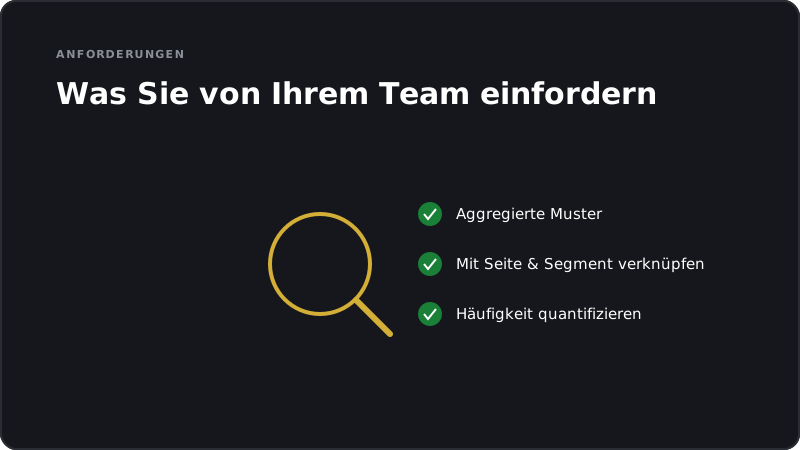
These requirements make recording analyses actionable for you. They prevent your team from spending hours on videos only to deliver anecdotes at the end.
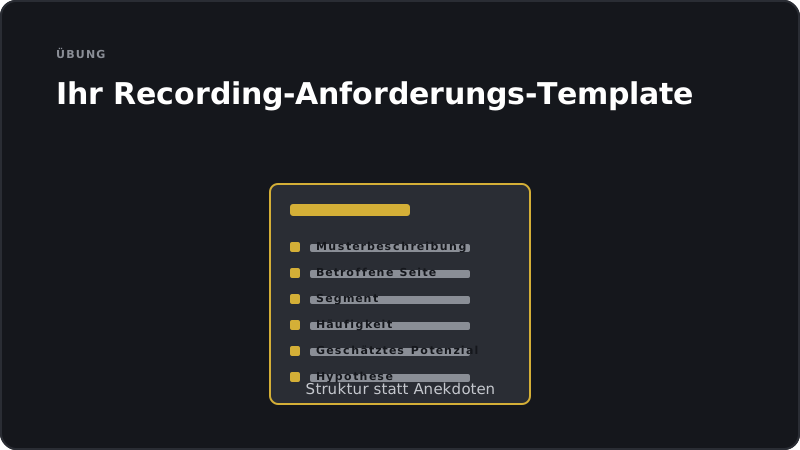
This exercise moves you from passive observation to active management.
Recordings are a powerful tool, but they have limits. They show you the what, not the why. That's why you should combine them with other methods, especially A/B testing for validation.
This case study shows what combining recordings with a scrollmap looks like in practice. Together, they paint a clear picture. The test then validates the solution. That's the ideal Clarity workflow.
This misconception leads to costly misjudgments. A single user can do almost anything. Only a pattern repeated across many users justifies taking action or running a test.
Sampling is an important factor in Clarity. A pattern seen in five recordings is a very different thing from a pattern seen in five hundred. Make sure your team accounts for the total population.
These four steps are your workflow. They take you from qualitative observation to quantitative validation. Without this workflow, recordings are nothing more than a collection of anecdotes.
Your role isn't to watch videos. Your role is to manage the process and make business decisions. Recording analysis is a team tool; the decision is yours.
The key takeaway from this module: recordings are a hypothesis tool, not a proof tool. Their value only emerges through aggregation and connection to tests.
These three habits turn session recordings into a strategic asset. Aggregate, document, test. That's the formula.
In the next module, we'll go deeper into aggregated visualizations. Heatmaps and scrollmaps are often faster to read than recordings, and they're just as valuable for generating hypotheses.
Apply what you have learned right away.
A quick look back before you continue.
This module comes with two PDF downloads you can apply right away:
After completing this module, you'll know how to watch session recordings with purpose instead of browsing at random: you'll prioritize the right recordings (near-buyers, engagement without conversion, underperforming segments), recognize the four core patterns (rage/dead clicks, back-and-forth scrolling, quick drop-offs, repeated form entries), and ask your team for aggregated, quantified patterns rather than individual videos.