JDKRUEGER&COAcademySign inDE
Module 1 of 4 · Google Analytics 4 for CRO

GA4 as a Decision-Making Tool

⏱ 25 min · After completing this module, you'll be able to use GA4 as a strategic management tool: instead of vague questions like "How's the shop doing?" you'll ask targeted diagnostic questions about funnel gaps, underperforming segments, and traffic quality, and you'll expect segmented, action-oriented answers from your team without having to build the reports yourself.
← Google Analytics 4 for CRO GA4 as a Decision-Making Tool 1 / 23
continuing in 5
Start

GA4 as a Decision-Making Tool

What Google Analytics 4 actually delivers, and why the value lies in asking the right questions, not in building more dashboards.

GA4 as a Strategic CRO Management Tool
Transcript of this slide

Welcome to the GA4 track. Many shop owners treat Google Analytics 4 as a pure reporting tool. In this module, you'll learn how to use GA4 as a strategic management instrument, without having to build reports yourself.

Learning objective

Learning Objective

You'll distinguish between operational dashboards and strategic decision questions.

  • You'll formulate specific questions your team should answer using GA4.
  • You'll recognize when GA4 data alone isn't enough and A/B testing is needed.
1
Formulating questions
2
Requesting data
3
Deriving decisions
Transcript of this slide

After this module, you'll stop making vague requests like "How is the shop doing?" You'll ask specifically about levers, gaps, and action options, and get answers that justify budgets.

Concept

The GA4 Paradox

GA4 delivers more data than ever before, yet many decision-makers feel less informed.

  • The reason: GA4 was built for analysts, not for shop owners.
  • Anyone who uses GA4 only as a reporting system gets lost in the details and misses the strategic lever.
Data Overload vs. Decision Clarity
Transcript of this slide

More data doesn't automatically mean better decisions. GA4 is powerful, but without a clear question it becomes a data graveyard. The skill is in narrowing the tool down to the questions that actually matter economically.

Concept

What GA4 Delivers for CRO Decision-Makers

GA4 shows where users drop off, not just how many.

  • GA4 connects behavior with devices, sources, and audiences.
  • GA4 makes conversion paths visible that were previously hidden.
1
Drop-off points
2
Segments
3
Conversion paths
Transcript of this slide

For CRO, GA4 is valuable because it surfaces causes. The absolute number isn't what matters. What matters is the pattern behind it: where are we losing prospects, and which groups are hit the hardest?

Concept

The Three Levels of GA4 Usage

Level one: Reporting. What happened?

  • Level two: Diagnosis. Why did it happen?
  • Level three: Forecast. What should we test next?
1
Reporting
2
Diagnosis
3
Forecast
Transcript of this slide

As a decision-maker, you primarily need levels two and three. Your team can handle reporting. Your job is to evaluate the diagnosis and derive test priorities from it.

Example

Example: The Checkout Gap

A shop sees in GA4: 68 percent checkout abandonment.

  • The diagnosis shows: abandonment is concentrated on mobile and on step two, shipping costs.
  • The forecast: a shipping cost transparency test could lift mobile conversion.
Checkout Funnel with Mobile Drop-Off Point
Transcript of this slide

This example shows the difference between a number and a basis for decision-making. Without segmentation, the abandonment rate is just an average. With segmentation, a clear test idea emerges.

Concept

Events Instead of Page Views

GA4 thinks in events, not pages. A click, a scroll, a purchase: everything is an event.

  • That allows for more precise questions: who scrolls how far, and who starts the checkout but abandons it?
  • For decision-makers, this means: data quality depends on which events are being tracked cleanly.
1
page_view
2
add_to_cart
3
begin_checkout
4
purchase
Transcript of this slide

You don't need to set up events yourself. But you should know which events are business-critical for your shop and whether they're being captured correctly. That's a governance question, not an operational one.

Concept

The Most Important GA4 Questions for Decision-Makers

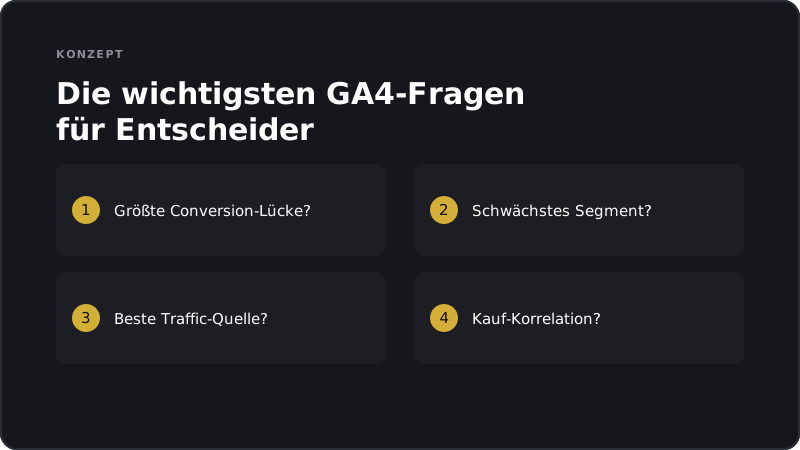
Where is the biggest conversion gap in the funnel?

  • Which segment is underperforming most compared to the industry average?
  • Which traffic source delivers the highest quality, not just the most visitors?
  • Which pages or events correlate with completed purchases?
The Four GA4 Questions for CRO Decision-Makers
Transcript of this slide

These are four questions you should be asking regularly. They lead directly to test ideas, budget decisions, and prioritization. Keep them in mind as your GA4 decision-maker checklist.

Scenario

Scenario: Two Shops, Same Abandonment Rate

Shop A: 70 percent checkout abandonment, spread evenly across all steps.

  • Shop B: 70 percent checkout abandonment, but 55 percent concentrated on step two.
  • Shop B has the clearer lever, and therefore a better chance of a quick test win.
Same Number, Different Levers
Transcript of this slide

Averages are deceptive. Two shops with identical abandonment rates can have completely different problems. GA4 helps you spot those differences, and the right diagnosis is the first step toward the right action.

Concept

When Is GA4 Data Not Enough?

GA4 shows what happens. It doesn't automatically show why something happens.

  • When two variants are possible, GA4 doesn't provide a causal answer.
  • For "What works better?" you need A/B tests, not just analytics.
Analytics explains patterns. Tests explain causality.
Transcript of this slide

GA4 is the microscope, A/B testing is the experiment. Both together are powerful, but don't confuse the two. If you rely on analytics alone, you're often optimizing symptoms rather than root causes.

Concept

The Decision-Maker's Role

You define which questions get asked.

  • You assess whether the answers are strategically relevant.
  • You decide when data turns into a test hypothesis or an operational action.
1
Define questions
2
Evaluate answers
3
Approve actions
Transcript of this slide

Your team delivers data. Your job is to translate that data into action. That only works if you're asking the right questions before the dashboard is even opened.

Exercise

Exercise: Your GA4 Question Set

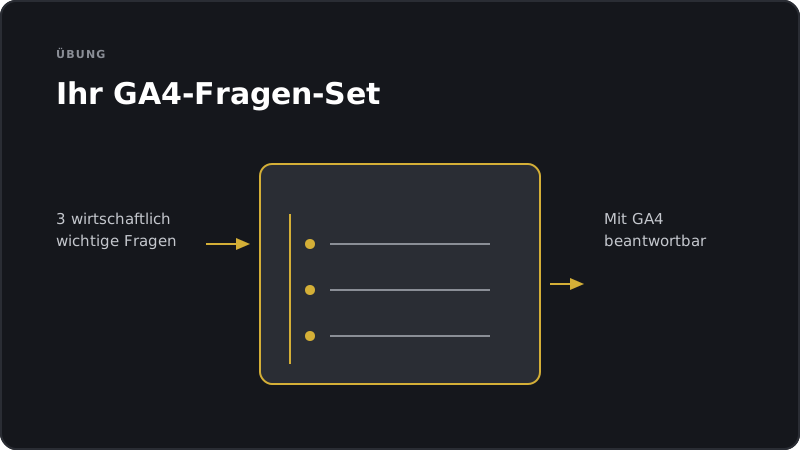
Write down the three most important business questions you currently have about your shop.

  • Frame them so they can be answered with GA4.
  • Mark which question could directly lead to a test hypothesis.
Three Questions Your Shop Must Answer
Transcript of this slide

This exercise matters more than any dashboard view. Without a precise question, data won't move you forward. Make your questions as specific as possible.

Concept

Data Quality as a Prerequisite

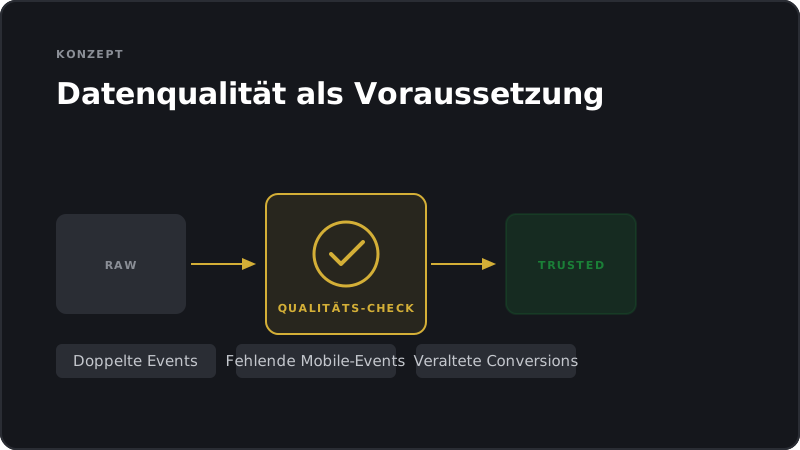
Incorrect or incomplete events lead to incorrect decisions.

  • Typical issues: duplicate purchase events, missing mobile events, outdated conversions.
  • As a decision-maker, you should regularly ask about data quality, not about how the tool works.
Data Quality Over Data Volume
Transcript of this slide

Data quality isn't a technical side note. It's the foundation of every decision. A single incorrect purchase event can send an entire test strategy in the wrong direction. Ask about it.

Common misconception

Misconception: "I need to be able to operate GA4 myself"

Reality: Decision-makers don't need to operate GA4. They need to use it correctly.

  • Operating the tool is the job of analysts, agencies, or your team.
  • Your competitive edge comes from the quality of your questions and decisions.
Operating vs. Steering
Transcript of this slide

Many shop owners spend time learning to use GA4 instead of learning which questions to ask. The goal of this track isn't tool operation. It's strategic confidence.

Example

Case Study: The Mobile Shipping Cost Effect

A fashion shop discovers in GA4 that mobile checkout drop-off rises sharply after step two.

  • The hypothesis: shipping costs are displayed too late and too prominently on mobile.
  • The A/B test shows that earlier, transparent display of shipping costs reduces mobile drop-off by eight percent.
19 39 58 77 70 Before 62 After
Transcript of this slide

This is the ideal scenario: GA4 shows the pattern, the test proves the cause. Without GA4, it would have stayed a hunch. Without the test, the action would have stayed a guess.

Summary

Summary

GA4 is a strategic diagnostic tool, not just a reporting tool.

  • The four decision-maker questions reveal levers, segments, and test opportunities.
  • Data quality and clear questions matter more than a flood of dashboards.
1
Strategic questions
2
Segmented diagnosis
3
Test hypotheses
Transcript of this slide

The key takeaway from this module: GA4 becomes valuable when you narrow it down to the questions that matter economically. Fewer dashboards, more decisions.

Summary

What You're Taking Away

Before every GA4 report, define the question it needs to answer.

  • Demand segmented answers, not just averages.
  • Always connect analytics data to a test or action hypothesis.
From Report to Decision
Transcript of this slide

These three habits mark the difference between a shop that collects data and a shop that uses it. Question, segment, hypothesis. That's the sequence.

Intermediate step

What's Next

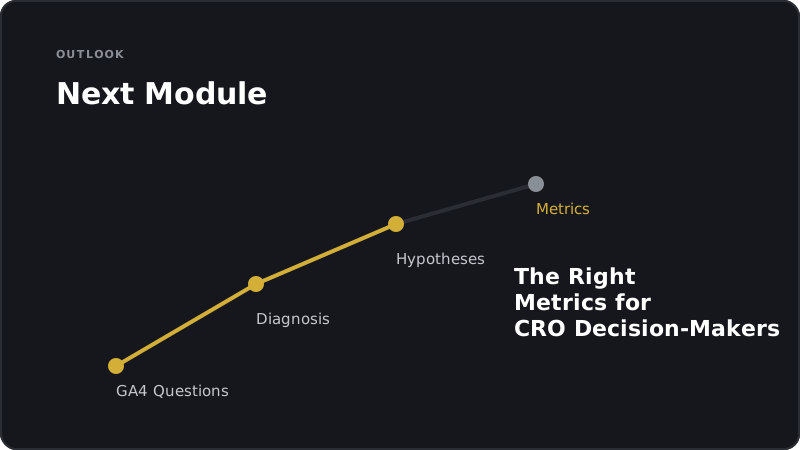
In the next module, we'll look at the metrics that actually matter for CRO decision-makers and how to protect yourself against misleading numbers.

Next Module: The Right Metrics
Transcript of this slide

In the next module, we'll go deeper on metrics. Not every number in GA4 is relevant for CRO. We'll separate what matters from what distracts.

Quiz

Quiz

Test your knowledge.

What is the key question a decision-maker should be able to answer with GA4?

What does the maturity matrix mean for a company in the context of GA4?

What three core questions should decision-makers regularly answer with GA4?

Why should vanity metrics like raw page views be viewed with skepticism?

What is leadership's role when introducing GA4?

Exercise

Exercise

Apply what you have learned right away.

  • 1
    GA4 Question Check
    worksheet · approx. 15 min
    Write five precise GA4 questions about your shop that lead directly to a business decision. Avoid questions that only describe ('How many visitors?'). Look for questions that diagnose or forecast.
  • 2
    Segment Gap Scan
    audit · approx. 20 min
    Have your team show you the three most important segments in your checkout: device, traffic source, and new vs. returning customer. Note where the biggest gap to desktop or average performance shows up.
Reflection

Reflection

A quick look back before you continue.

  • Which vague GA4 request you've recently sent to your team would you now rewrite as a precise, segmented question after completing this module?
  • Where in your own funnel do you suspect the biggest conversion gap - and what segmentation would prove whether you're right?
  • Which business-critical event in your shop would you have checked for accurate tracking first, before basing a testing decision on it?
Finish

Module completed

Next module: The right metrics for CRO decision-makers

Hands-on material to take away

This module comes with two PDF downloads you can apply right away:

  • Job-Aid: The core message condensed onto one page, ideal for quick reference before decisions.
  • Worksheet: A fillable worksheet to adapt what you have learned to your shop.

Overview & learning objective

This module is aimed at shop owners.

After completing this module, you'll be able to use GA4 as a strategic management tool: instead of vague questions like "How's the shop doing?" you'll ask targeted diagnostic questions about funnel gaps, underperforming segments, and traffic quality, and you'll expect segmented, action-oriented answers from your team without having to build the reports yourself.

GA4 as a Decision-Making Tool